
This past weekend I drove a little over two hours to Fort Wayne, Indiana to attend the 48th Winter Fantasy convention. It’s a smaller convention with a heavy focus on Adventurers League play as it’s put on by Baldman Games. I’ve been to Winter Fantasy a few times before this, and the memories have blurred together in an odd (and somewhat off putting) way. I went to my first Winter Fantasy because it was the premiere of the first AL adventure I ever wrote, Moon 7-2 the Temple of the Sun. I returned the next year and ran some more Moonshaes mods and the second Avernus epic. The convention was entirely online in 2021 because of the pandemic, but I drove down the following year as a foot of snow piled up and ran the second half of the Wild Beyond the Witchlight. I ended up staying home in 2023 as I had transitioned into convention management at work and was going to be working at Emerald City Comic Con and PAX East in March. Too many shows, too little time.
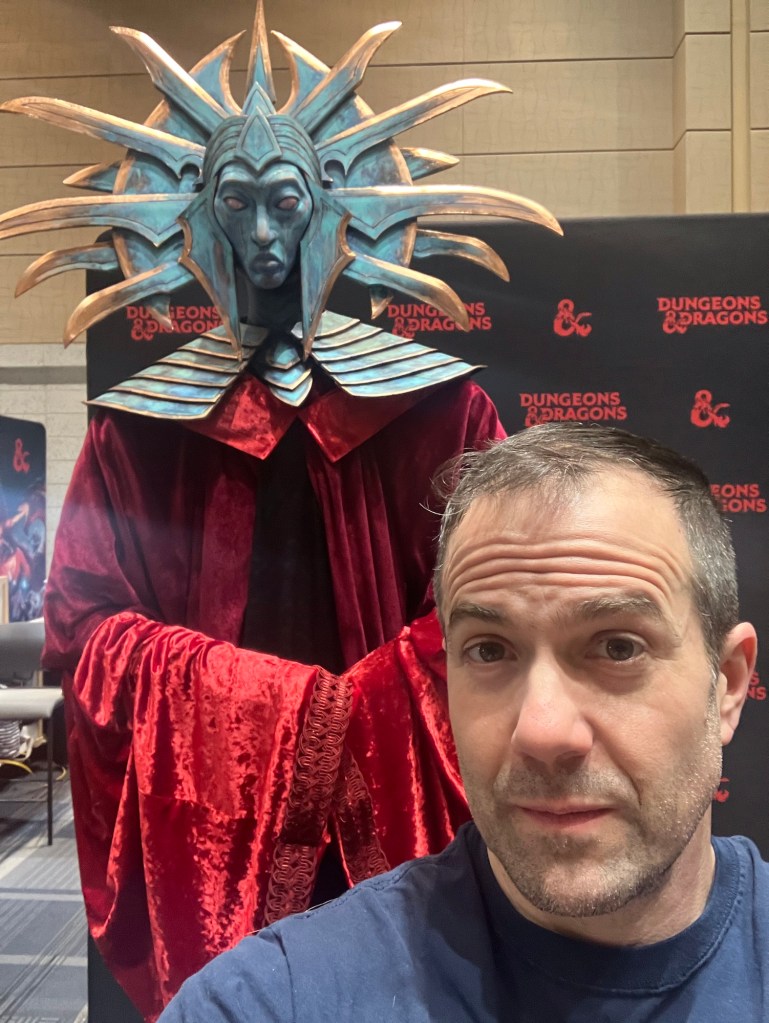
I’m sitting out PAX East this year, so Winter Fantasy was back in the cards. I only went down for Thursday and Friday because my daughter’s birthday fell on Saturday during the convention. Quick trip, for sure, and I missed out on the Planescape epic featuring Eric Menge’s fantastic Lady of Pain puppet. Ah, well!
I wanted to do something other than run AL games, so I ran an adventure of my own making called A Long Night At The Yawning Portal. It’s a bit of a reimagining of the first chapter of Waterdeep: Dragon Heist. I think Dragon Heist is a bit of a jumble of tools from which a DM can make a great game. I certainly enjoyed running it and using supplements like Blue Alley and Durnan’s Guide to Tavernkeeping to breathe life into the city. The book has some great NPCs. I voiced Renaer Neverember as a stammering Hugh Grant type in my home game, and then Hugh Grant ended up being the lord of Neverwinter in the movie, D&D: Honor Among Thieves! And of course, Waterdeep sits above Undermountain, one of the most famous megadungeons of all time, so the city is rich with potential for adventure.
But yes, I felt some reimagining was in order. For one thing, Dragon Heist opens with a scene where a troll covered in stirges crawls up and out of the well in the Yawning Portal one evening. The players get to handle the stirges and an NPC will take care of the troll if needed. I generally don’t care for that sort of intervention. Let the players figure it out! In this case, I suppose it’s fair play, but it pushes up against the Forgotten Realms’ problem of, “why are the PCs needed when Drizzt and Elminster could be handling things?” But that’s a topic for another day. After the troll is sorted out, the players get sent on a breadcrumb trail to rescue a missing person, and I don’t care for linear investigations either. I actually didn’t use the chapter from the book when I ran Dragon Heist. Instead, I used one of the alternate openings from Dragon Heist: Forgotten Tales. There was such good supplementary material for WotC’s adventures published on the DMsGuild by the Guild Adepts program for a few years there.
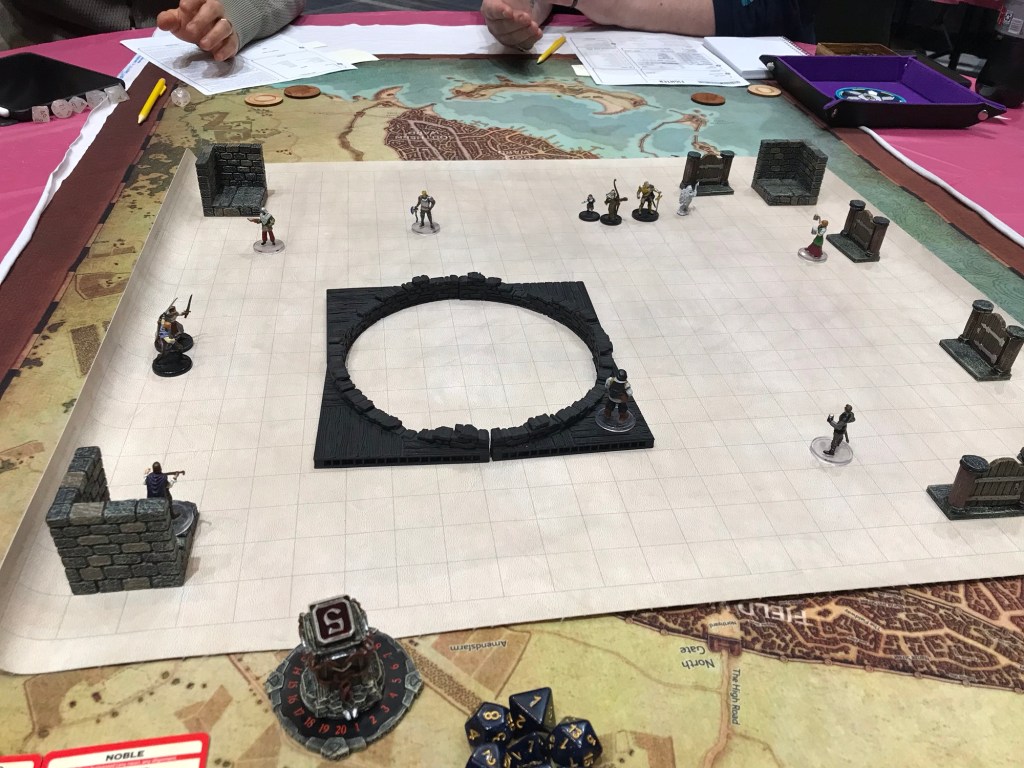
So I set out primarily to place agency back into the players’ hands, and to introduce the various factions that can show up throughout Dragon Heist. I used the first level pre-generated characters from Mike Shea’s Ruins of the Grendleroot. These character sheets are neat in that they scale from first to fifth level, with the compromise being that if you’re only playing at first level, there’s a bit of clutter from the higher level material. But they’re well designed, and my players all got the hang of them fairly quickly.
I chose to use first level characters to keep things mechanically simple, to encourage the players to come up with creative solutions rather than looking for answers in their character abilities, and so this adventure could replace the first chapter of Dragon Heist. This gave the game an unexpectedly old school feel. Combat was fast and deadly, blind corners and closed doors were frightening, and one group almost TPKed to four goblins (RIP, ranger) and again to a gelatinous cube (RIP, dragonborn paladin). It was loads of fun and one player actually said it was the first time they weren’t annoyed by the limitations of first level play.
The players all drew cards that had different backgrounds and rumors on them. The rumors all revealed information about the factions in play at the Yawning Portal and in Undermountain. The backgrounds all specified why each character needed a new place to live. Most of them were somewhat comical, like, “You ran afoul of a park druid and were cursed with bedbugs, and now no inn will house you for more than a night” or, “Your parents joined the Cassalanter prosperity cult, sold your family home, and moved into the Cassalanter villa, leaving you to fend for yourself.” This gave each character a reason to be at the Yawning Portal that night, as Volthamp Geddarm was holding a competition, the prize of which was the deed to Trollskull Manor.
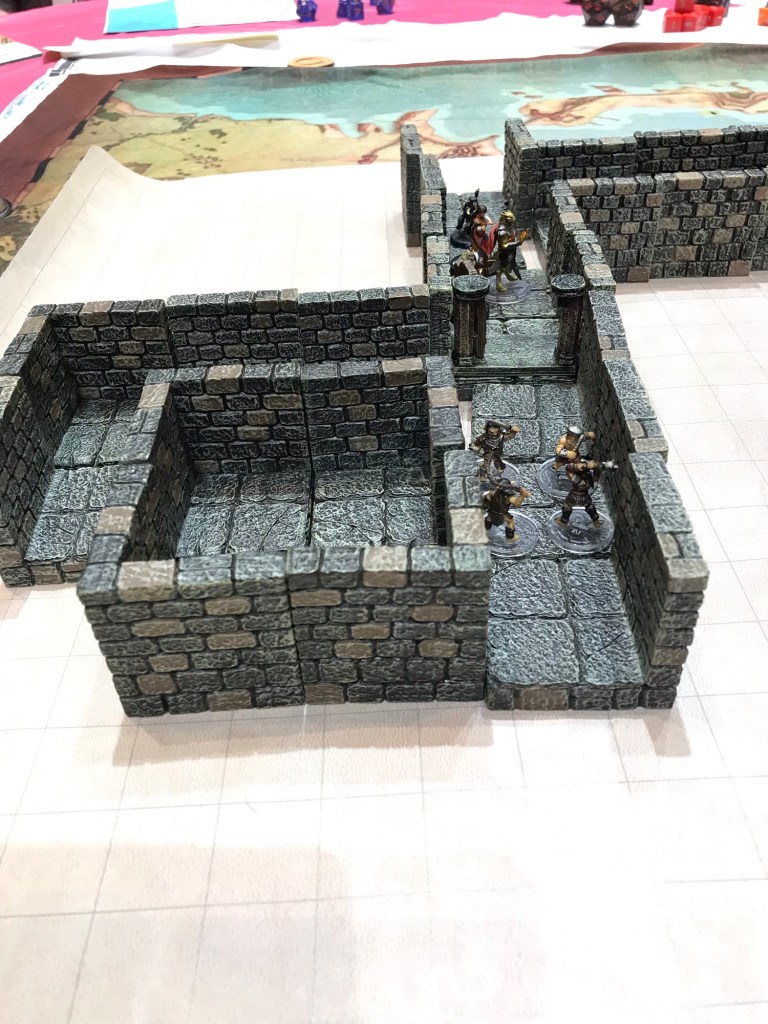
One of the rumors was that Volo needed money because his Guide to Monsters had been deleted by the publisher, and the competing adventuring parties got to bid for the right to descend into Undermountain to find and retrieve a white rabbit almiraj to win the prize. Higher bids earning earlier starting times. The PCs had the opportunity to negotiate with the representatives from various factions, all of whom wanted different favors in return for funding.
From this point on, each run through of the adventure took on a different story. Some immediately hired on with the rich kids Renaer and Floon. One group played the Harpers against the Zhentarim, taking funds from both, and another party accepted coin from a man in a purple velour suit to go down a secret entrance on a different mission entirely. I think this was enjoyable for the players and it made it possible for me to run it four times in two days without it feeling repetitive.
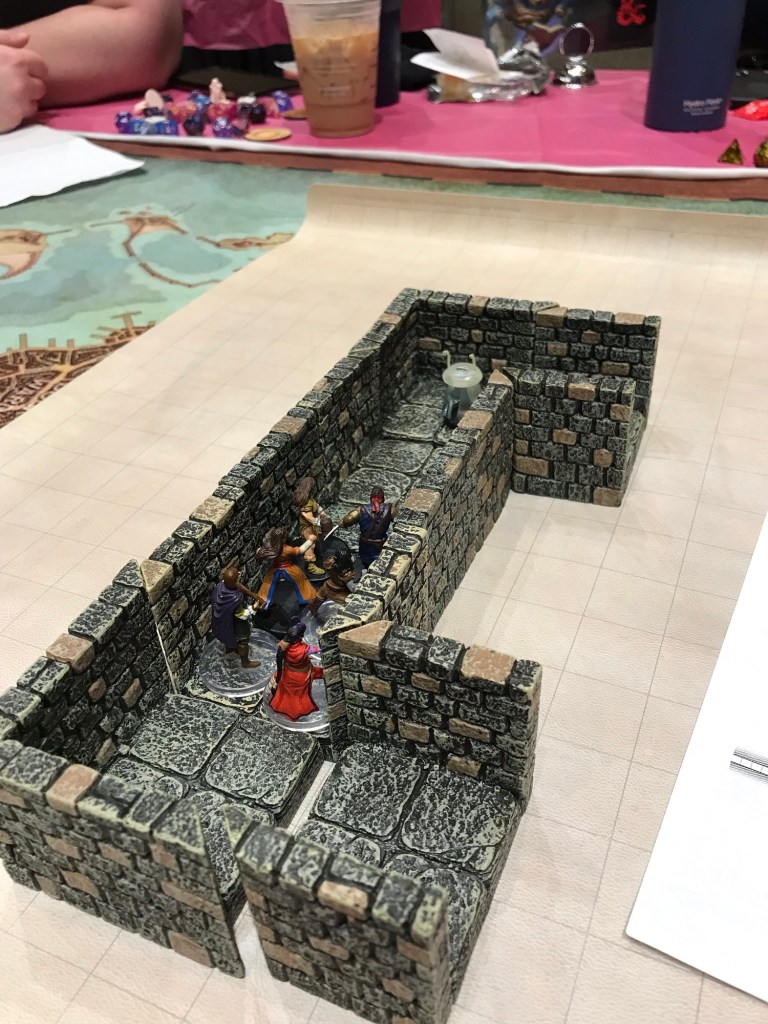
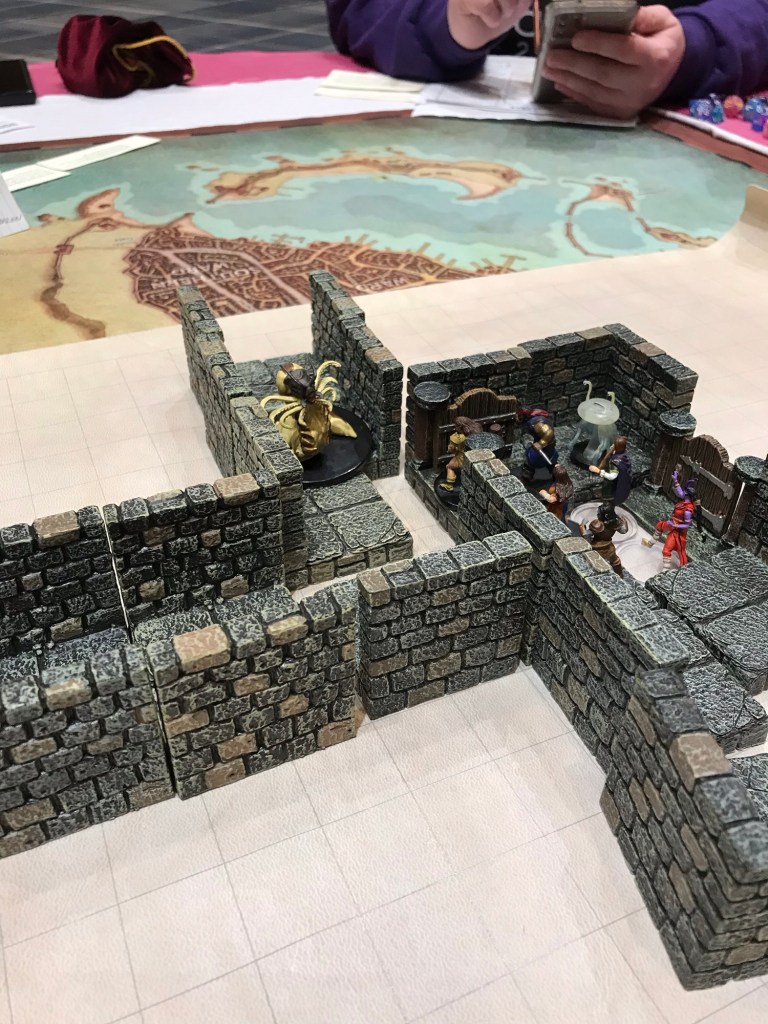
I used random encounters to drive the dungeon exploration. My personal Undermountain is a mashup of the all the published material from the AD&D 2nd edition box set, 4e’s Halls of Undermountain, and 5e’s Dungeon of the Mad Mage. This expands the first level of dungeon past Mad Mage’s one-page map and breathes more life into the various chambers. However, I didn’t key encounters to specific rooms, as I wanted the dungeon to be a living place. I had a six sided die on display to the players (visible in the Yawning Portal picture above) and every time they went around a blind corner or through a door, I would have a player roll a d6. If the result was equal to or less than the die on display, then I would roll on the random encounter table. If it was higher, then there was no encounter, the encounter die advanced upwards by one, and they could press on. This meant that they knew they would run into monsters eventually and it gave the game an air of apprehension alternating with the relief of temporarily dodging the inevitable dangers of the dungeon.

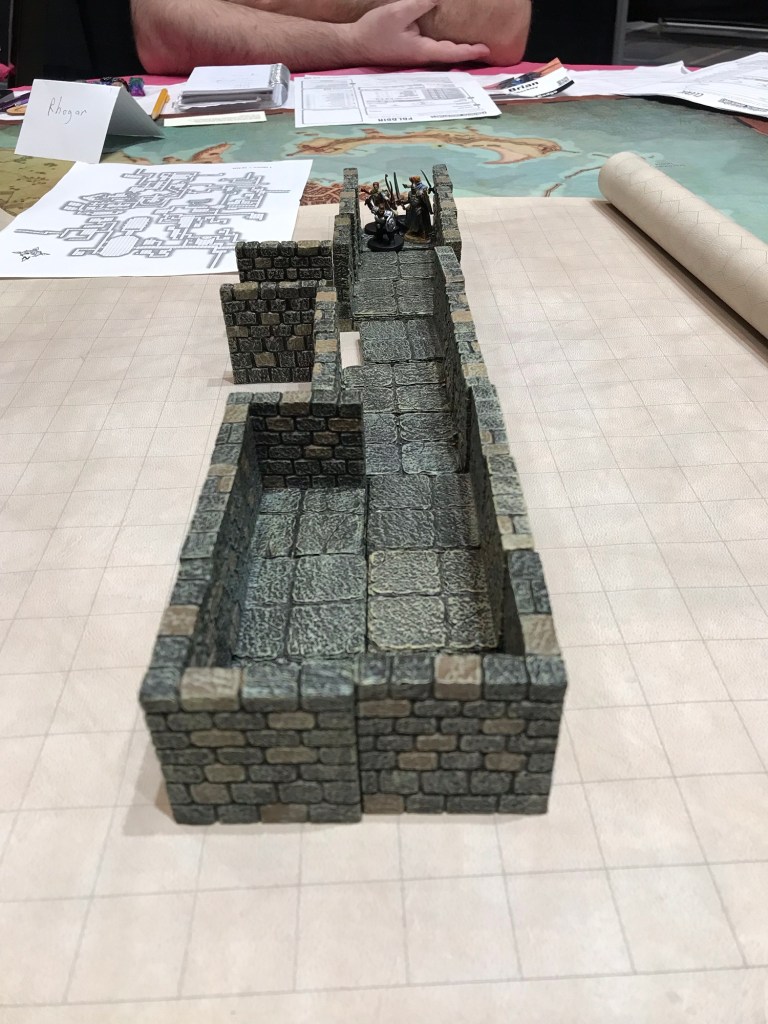
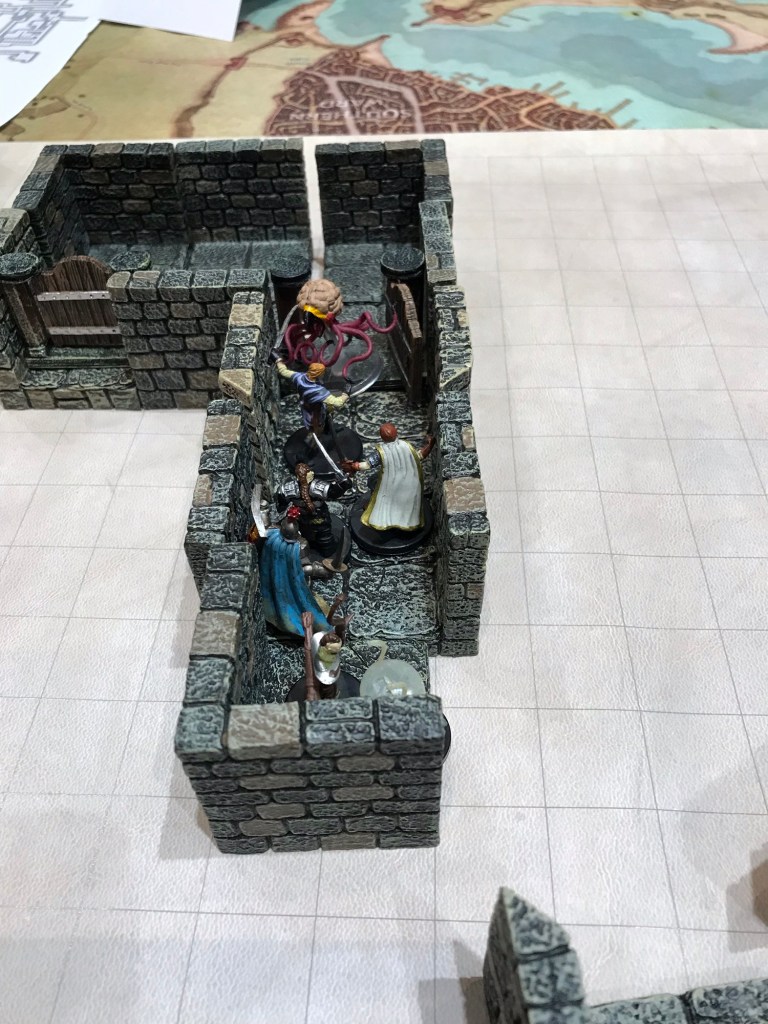
I brought a single case of minis and terrain to run the game. As the players were free to go anywhere in Undermountain, I couldn’t do an elaborate pre-build. Instead, I had a handful of corners, walls, and passages that I could quickly arrange into whatever hall or chamber they found themselves in. Terrain and minis always look neat, but in a complex environment like a dungeon, I find it really helps to present the space visually. Using scatter terrain is also a significant time savings over drawing and erasing on the gridded mat.
So that’s another Winter Fantasy in the books! I got to see friends and eat great food, and I got the new Book of Many Things for running four slots. Good times, even if Fort Wayne doesn’t seem to hate money like it used to and it was warm enough go without jackets.

 Proving Grounds of Folkvangr