
My previous post was predictably polarizing on Reddit (and wound up inexplicably locked. Was it really low effort? I guess I could have done a copy-paste instead of linking the blog to make it look like it was more work). Some folks concurred and built upon what I said, others were upset that I would dare suggest such a thing despite the caveats I included. Most of all, I was led by common misunderstandings to wonder if I can’t write or they can’t read, or if both are true simultaneously.
To quickly sum up: I think what made roleplaying games matter was open, emergent play. Linear adventures generally aim to constrain this and end up creating new problems for the DM. These problems are difficult to solve because they go against the fundamentals that the game is built on.
But what does this have to do with minis? When I paint, I often get restless after ten or fifteen minutes. I want to check my phone, or have a snack, or run off and do anything else. But if I can take a breath and push through that feeling, I enter a wonderful state of presence that is all too rare these days. I’m house-sitting this week and I brought my unpainted Dwarven Forge dungeon pieces to work on while I’m here. After doing the first coat of lava red on a few pieces, I definitely wanted to run off and read or play Breath of the Wild or do anything else. But once I got through that initial discomfort, it felt really good, and I could paint for a long time. And after that, I’d gotten a lot done!
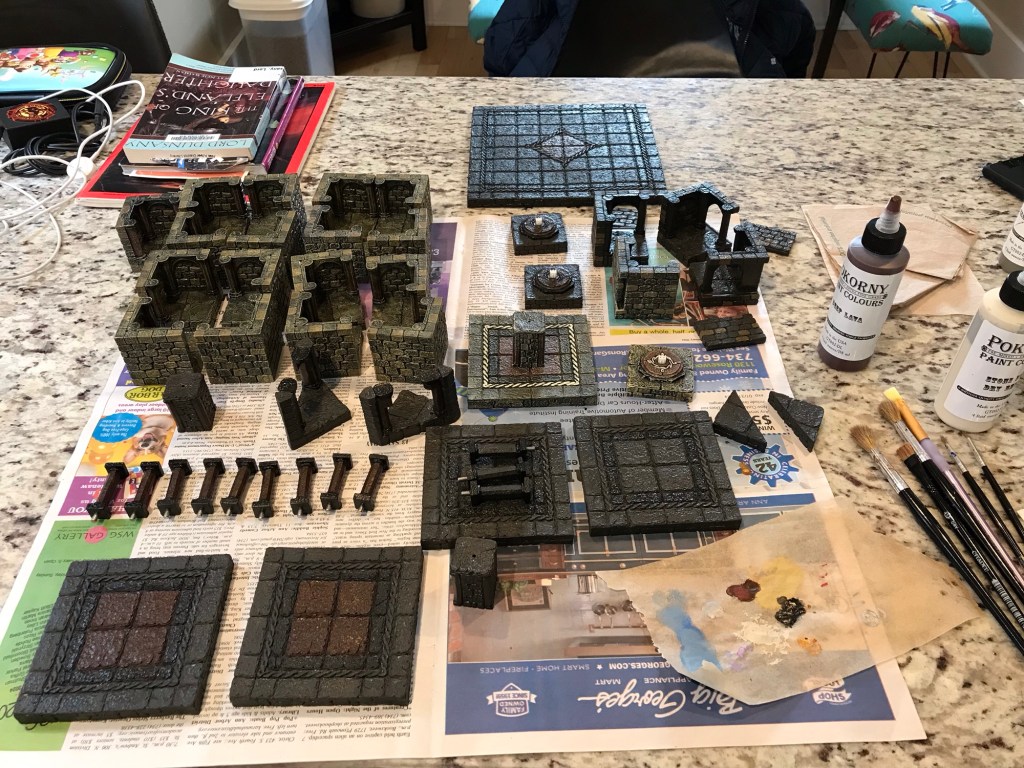
I feel better for the rest of the day after a good painting session, just like when I lift weights or really sink into a book. The King of Elfland’s Daughter is written in such a way that I have to be present to read it. If I’m distracted, the dreamy prose tumbles by without meaning. It can be challenging to unplug from the static of modern life and get into the right attentive state to enjoy a book like that, but it’s also really worth it. I’m not very good at it. In fact, I’m terribly distracted in general. My kids and dogs frequently interrupt me, and it’s so much easier to “push button, receive social media.” Weeks can go by without my picking the book up. But I recognize the value in the practice, and I want more of it in my life.
I took a brief trip down the blog rabbit hole this morning and wound up at this entry on Monsters and Manuals, We Need Long Campaigns, via Grognardia. I agree completely. Again, this isn’t fun policing, or telling you your play style is wrong. It’s saying that there is value in slowing down and being present and building something that can only be done over time and with patience. It’s deeply valuable in our modern culture. We genuinely need it, just like we need time outside and we need exercise and vegetables. Your life, not just your games, will be richer for it.
When I first saw people call modern adventure books “campaigns,” I was confused. What do you mean? The campaign ends when the book ends? It’s quite different from the original concept of the adventure module. The word module is essential there. Adventure modules were generally intended to be plugged into your ongoing campaign as you saw fit. The campaign didn’t end when the module did, instead you carried on to something else. I still love yanking pieces out of books and stitching them together. My Waterdeep: Dragon Heist nearly ended in when only a PC or two survived Death House (from Curse of Strahd) and Salvage Operation (from Ghosts of Saltmarsh). But I think it’s telling when people play through these adventures and then afterwards can’t remember the names of their own characters. It happens often enough, and it’s sad. In this cultural age when everything is available but everything is disposable, we should strive to find something that sticks with us.
 Proving Grounds of Folkvangr