
I spent most of September writing a forty room, heavily interconnected dungeon for a freelance project. That was a good time and I’m pretty happy with how it turned out. When I say heavily interconnected, I mean heavily interconnected. I’ll go into my approach at a later date, but the 50% turnover looked like a conspiracy string board with all my notes about which rooms connected to which, and which ones were parts of link chains (area 5 points to area 12 which points to area 7 and so on…). Luckily my editor seemed happy with it! So more on that at some future date.
I rolled right out of that into the October Virtual D&D Weekend, put on as always by Baldman Games, at which I ran (say it with me in your best Matt Colville impression) Against the Cult of the Reptile God! (exclamation his). It was a good time and proved it deserves its classic status. I figured I should throw down some notes about running it, how it went using 5e 2024, and what I would change if I had time and was going to run it again.
Spoilers for Forty Year Old Adventure Ahead! As the old modules say, “If you intend to play in this adventure, READ NO FURTHER!“

As Written. I feel AtCotRG (oof, that’s an ugly acronym) is one of the better old school modules due to its open structure. It’s presented in two parts, the village of Orlane and the dungeon of the reptile god, with some random wilderness encounters to bridge the transition from the former to the latter. Orlane is a town with a problem, namely that a spirit naga in a nearby swamp has been charming the locals to form a cult. To what end? I’m not sure! But half the town is charmed, and the other half is frightened. The characters walk into the middle of this, poke around, and eventually find out there’s a dungeon to be delved and a reptile god to be killed if things are to be set right.
At no point does the adventure force the DM’s hand, and it’s all the better for it. The village and its inhabitants are keyed to locations with the cultists clearly called out for quick scanning. The villagers actually warn the party against staying at the cultists’ inn, which my players cued in on and went directly to. Naturally, things went right off the rails, or would have, had there been any rails in the first place. As written, the cultists plan to kidnap the sleeping PCs at two in the morning. If the PCs aren’t there, or if they get up at midnight to shake down the innkeeper for information like mine did, the DM is left free to improvise.
There’s no need to force the PCs into the kidnapping. This is such a relief. One of the things at the forefront of my mind when I read any adventure, especially linear ones, is, “how am I going to get the players to do that?” It’s usually because of the fragility of linear structures. Adventures like Hoard of the Dragon Queen, where every chapter opens with the party being asked to run some new errand on someone else’s behalf, fall apart the first time a character replies, “mm… No.”
Instead, the village is full of weirdos. Some ask for help, some brush you off and claim there’s nothing wrong, and all of them kindle suspicion. Players can’t help but poke around when given that sort of a situation. They want to know what’s going on. This sort of intrinsic motivation beats, “here’s 500 gp to go see why the old well’s blocked up (because I can’t be bothered)” quest requests any day of the week. Put weird stuff in front of the players. Dare them to poke at it. They will!
What Happened. My players headed straight to the cult inn after talking to a few of the locals and, as I mentioned previously, planned to get some rest and then poke around at night. They found the cultists laying in wait for them and soundly trounced them, then caught the innkeeper sleeping and interrogated him. They then waited for the cultists’ reinforcements who, finding the inn not as expected, turned around. The players followed them to their stronghold in town, caught one of the leaders sleeping, and shook them down for directions to the dungeon.
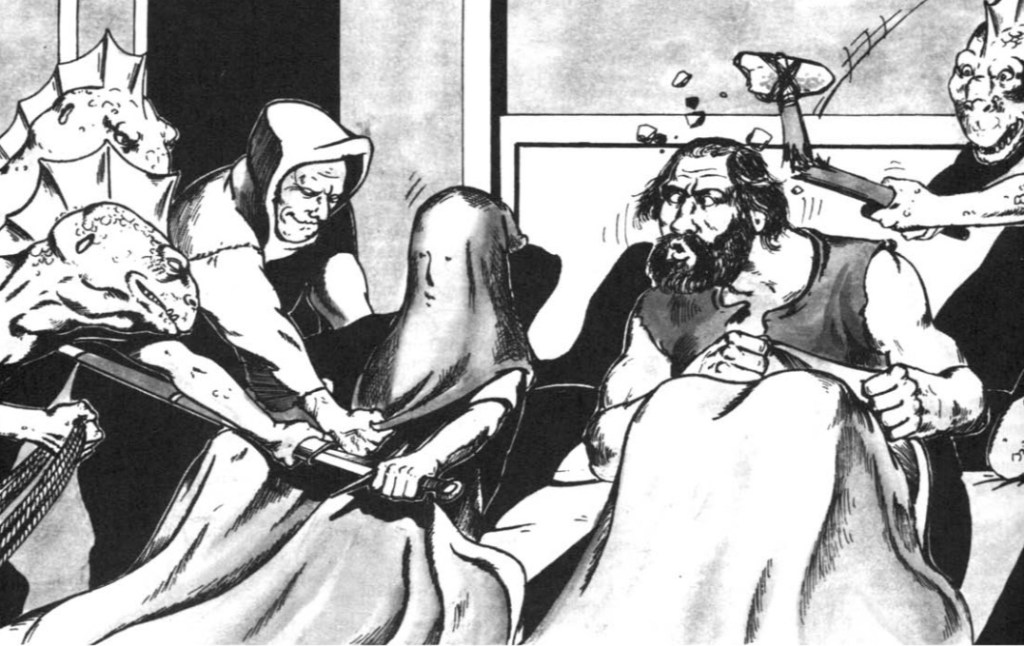
The characters descended into the earthen mound under which the cult’s dungeons lay. They bluffed their way past the guards and then lucked out, heading virtually straight for level two. A player did spot my failure to adequately conceal the secret door on the map, but whatever, we only had eight hours to play so I let them have it. Luck was in their favor on level two as well, or at least their fear of spiders served them, as they headed straight to the quarters of the head priest. That fight got a little bumpy as the priest is accompanied by a wight. Still, four characters (and a particularly useful familiar) against two bad guys put the odds in their favor. They took to smashing the cult’s iconography which triggered the secret door that led directly to the reptile god herself!
An Aside on the 5e Conversion. I generally pulled stat blocks of the same name and kept an eye out for when the numbers of enemies would be overwhelming. I figured most of the cultists, being brainwashed townsfolk, were best represented as commoners. This meant they tended to drop in one hit and we could move things along. The exceptions were cultists who had AD&D character levels. I originally intended to use the leveled sidekicks from Dragon of Icespire Peak, but the cleric sidekick is definitely a healer, so I used the 2024 cultist fanatic as needed. Assassins are serious business at CR8, so in that case I used the level 4 Expert sidekick.
Explictica Defilus, the reptile god, was a tricky case. She is a spirit naga in the original adventure and way overpowered for low level adventuring babies that walk into her lair. The module gets itself out of this jam by including a high level NPC who can protect them from her powerful opening salvo. My group didn’t meet the NPC, so they were on their own. But I had them bump up to fourth level before heading to the dungeon, so while the CR8 2024 spirit naga was still above their weight, they at least had a chance.
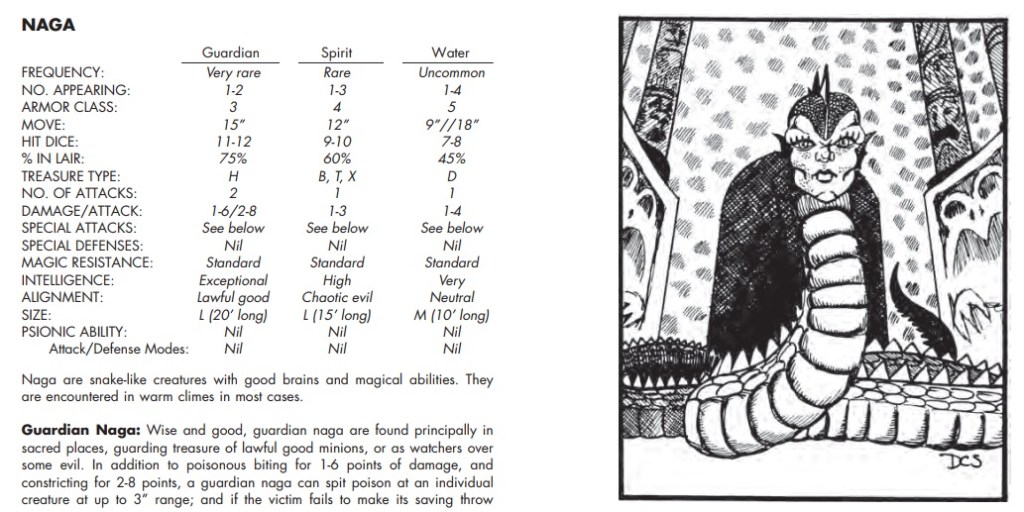
There’s another tricky bit with the spirit naga stat block. In AD&D, the naga’s charm was virtually permanent. In the 2014 Monster Manual, this had been walked back to casting dominate person once or twice a day. This is gone completely in the 2025 book. The spirit naga has a handful of utility and offensive spells, but it’s lost its mind control entirely!
This is indicative of an interesting shift from earlier editions of the game to the present. In AD&D, the game world was bound by certain rules which were applied more or less evenly to all of its inhabitants. Spells and character levels were reliably grounded. The 2014 version of 5e leaned in this direction, with spellcasting monsters being assigned class levels and such, although it didn’t commit to it. There was wiggle room at the margins. 2024 shifted things to take up that space. Spellcaster stat blocks lost their class levels and most of their extraneous utility spells in favor of pew-pew arcane blast, bursts, and Borts.
And so it was with Explictica. The spirit naga in 2025 shed its charming gaze, its dominate person, even its fireball. It has lightning bolt instead, which is kind of weird because its new (pew-pew) Necrotic Ray outdoes in damage in most cases.
I wavered on whether to use the 2014 spirit naga, the bone naga (which does have a hypnotic gaze), or the 2025 spirit naga. I ended up giving the 2025 spirit naga the bone naga’s gaze, which it only used once anyway.
The Dramatic Conclusion! The PC’s had wandered into Explictica’s lair through the secret back door. Threats were bandied about, blustering was done, and soon combat was inevitable. I was worried about the party’s chances, but my dice started off cold. Even with three attacks per round, Explictica missed most of the time. The party got off some big hits and whittled her down, but then my dice got hot. She took the entire group of PCs down two rounds, and settled back onto her treasure pile to watch them bleed out. In her arrogance, she neglected to take care of the familiar, who ran around administering healing potions. Combat resumed, characters were up and down and running out of spell slots. The paladin made a tactical error and nearly died but narrowly escaped. Explictica charged after him, killing the pesky familiar along the way. She just made it to the end of the tunnel beyond which the paladin was hiding, snapped at him, and missed! He countered with a killing blow! It was genuinely one of the most cinematic moments I’ve ever had in a D&D game, between the high stakes and the dramatic use of terrain. I could just picture the serpent biting from within the tunnel, narrowly missing as the hero stepped back only to return and cleave her skull in. It was great!
What Would I Change? If I was updating this module, I would make the connections between the NPCs more specific. This guy suspects that one, the cobbler cast aspersions on the wheelwright but it’s really because of an old grudge over an unpaid bill. As it is, the DM has to finesse things a bit to move them along. The suspicions are there, they could just stand to be a little more concrete. You could overlay a Landmark Hidden Secret structure, but it could become too much. It would be good if you really wanted to dig into the town and stay there a while. As it is, you’re probably going to figure out there’s a cult, and instead of going door to door rooting it out, you’re going to look to cut off the head. You don’t want too many distractions keeping you from the dungeon-y goodness of the second half.
I would like some more things that point at other things so that there’s some more personality spread around. The townsfolk all have Hommlet-style money stashed under their floorboards, but it would be better if they had some weird tchotchkes on their shelves or something of the sort to make the players wonder about them.
The second thing I might change would be to have multiple things that point to the dungeon. As written, there is no map, no singular NPC who gives the location away. The DM is left to just reveal its location as they see fit and in response to the players’ actions. And that’s nice! I would just like to have a little more of a safety net in case my players don’t follow the cultists heading out of town, or choose to sleep instead of raiding their local stronghold.
The structure of continuing kidnappings is solid, but again, the players need a little more to do around town to let that sort of time elapse. Maybe you’re seeding the surroundings with other adventure sites that the PCs can explore as red herrings, or just to make some coin while killing time in Orlane.
In the end, this is a sign of a good module. It’s solid on its own but also highly adaptable, ready for the DM to pull bits out and add things in to make it their own. All in all, it runs well and I’d do it again.
 Proving Grounds of Folkvangr